
Technology & Innovation

How the AJA-IV system works

Frame, attachment, anti-fall device, load control and lifting, as TianDe’s product materials describe them.

Frame

Frame and materials

The frame system’s components are bolted together into a 14 m high structure.

The manufacturer states that the aluminium-alloy members do not need repainting between uses.

Materials in detail

Main beams (guide rails), walkway boards, uprights and mesh panel channels are 6061-T6 aluminium-alloy extrusions, and the corrugated mesh panels are pressed from 3003 aluminium-alloy sheet. Steel is retained for parts that need high rigidity and have many welds, such as the lifting frames, support trusses and wall-mounted hanging seats. The hoist hangers are welded from square tube and steel plate, and the through-wall rods are M33 Q235 steel.

Frame components and materials

Main beam (guide rail)
6061-T6 aluminium-alloy extrusion
Walkway board
6061-T6 aluminium-alloy extrusion
Upright
6061-T6 aluminium-alloy extrusion
Mesh panel clamp channel
6061-T6 aluminium-alloy extrusion
Corrugated mesh panel
3003 aluminium-alloy sheet, pressed to a corrugated profile
Triangular connecting frame
Welded rectangular tube
Support truss
Welded rectangular steel tube

Attachment

Attachment to the building

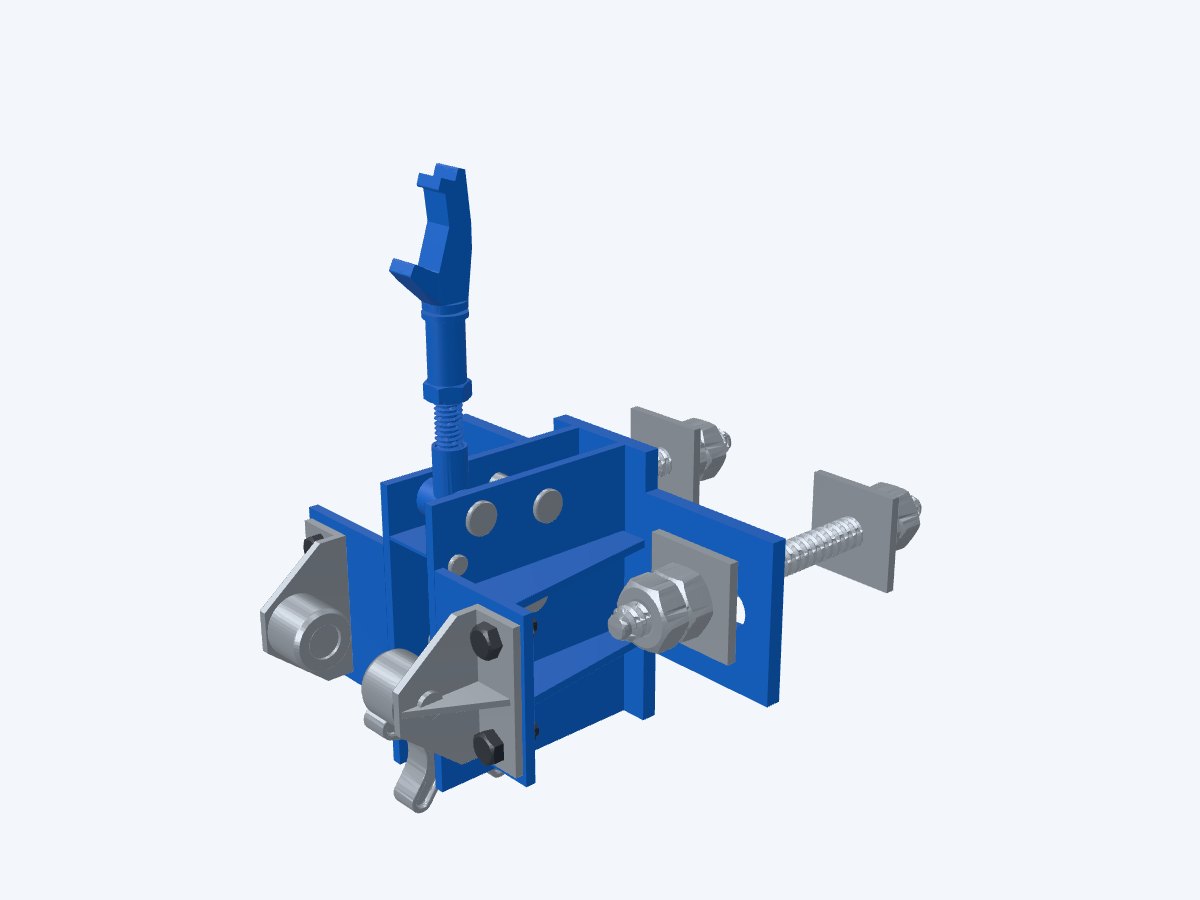
Each wall support carries a load-relief strut at its upper end, a guiding anti-tilt device at its front and a ratchet-and-pawl anti-fall device at the middle of its lower end.

Anti-overturning track and wall support

Two main-beam sections joined in series form the anti-overturning, anti-fall track, which connects to the wall supports fixed to the building and transfers the frame’s load to the building.

Through-wall screw rod
M33 rod, Q235 steel
Fixes the wall support to the structure.
Wall support
Carries the load-relief strut at its upper end, a guiding anti-tilt device at its front and the ratchet-and-pawl anti-fall device at the middle of its lower end, providing anti-tilt, anti-fall and load-relief functions.
Rendered view of the AJA-IV wall support CAD model: side plates, a forked top rod, pulleys, anti-fall parts and screw rods with nuts and washer plates.
Image unavailable. Rendered view of the AJA-IV wall support CAD model: side plates, a forked top rod, pulleys, anti-fall parts and screw rods with nuts and washer plates.
Wall support assembly, rendered from the 3D display model.Display model derived from the manufacturer’s CAD; not for engineering use.Explore the wall support in 3D

Anti-fall

Anti-fall Safety Mechanism

According to TianDe’s brochure, each wall support carries a ratchet-and-pawl anti-fall device: the main beam’s anti-fall slots act as the ratchet and the anti-fall bar on the wall support acts as the pawl. If the guide rail descends faster than the pawl can reset, the pawl props against a slot and prevents the frame from falling.

Anti-fall and anti-tilt devices are provided independently at every wall support.

This animation could not be played. The text below says what it shows.

On-screen title防坠工作演示 — “anti-fall operation demonstration”

Operation Demonstration

Shown without the support housing: the guide rail moves slowly downwards and the star wheel turns in its slots, beside the trigger and the forked top rod of the wall support. Towards the end the animation shows the rail dropping faster and then stopping, with the trigger between two arms of the star wheel.

Rendered animation from TianDe’s product materials (20 s; the original sound is not included)

Manufacturer’s mechanism animation: explanatory, not a physical test. The 3D models are CAD-based product visualisation and show structure only.

Open the wall-support display model with the anti-fall device selected. The 3D model shows structure only.

Explore the anti-fall device in 3D

Load control

Synchronous load control

Described by TianDe as an active safety device, the synchronous load control system monitors and controls the load at every lifting point in real time. It gives early warning of overload and load loss and controls both: it raises an alarm at 15% overload or underload and stops automatically at 30%.

Lifting is computer-controlled, with audible and visual safety alarms.

Controller thresholds

Alarm
15%
Automatic stop
30%

Computer-controlled; thresholds apply to overload and underload.

Lifting

Lifting and load path

The lifting system uses 7.5 t electric hoists mounted in an inverted arrangement.

  1. Frame self-weight and construction loads
  2. Lifting frame
  3. Electric hoist
  4. Wall-mounted hanging seat
  5. Building structure
The frame’s self-weight and construction loads pass through the lifting frame, the electric hoist and the wall-mounted hanging seat to the building structure.
Wall-mounted hanging seats

The wall-mounted hanging seats are the frame’s connection points with the building while it is raised or lowered; they anchor the hoist chains and transfer the load to the structure.

Company film

Sequences from TianDe’s company film

Edited sequences that explain the system. They are not installation or operating procedures.

The anti-fall animations are in the Anti-fall Safety Mechanism section.

This video could not be played. The description below lists what it shows.

System overview

Animated sequence from TianDe’s company film that introduces the three systems and labels their main components on screen in Chinese.

What the sequence shows
  • Frame system: main beams (guide rails), walkway boards, uprights, triangular connecting frames, support trusses and mesh panels
  • Attached support system: through-wall screw rods, wall supports, anti-fall devices and load-relief struts
  • Lifting system: electric hoists, lifting frames, hoist hangers, wall-mounted hanging seats and the synchronous load control system
Edited sequence from TianDe’s company film that explains the system. Silent clip; the original soundtrack is not included.
This video could not be played. The description below lists what it shows.

Installation sequence

Rendered sequence from TianDe’s company film showing stages of assembling the frame against a building.

What the sequence shows
  • Walkway boards laid on a temporary base platform of tube scaffolding
  • Main beams (guide rails), frame members and wall supports added at the floor edges, then mesh panels enclosing the frame
  • A control box beside a hoist chain, and an electric hoist
Edited sequence from TianDe’s company film that explains the system — not an installation procedure. It leaves out checks, fixings and site conditions. Silent clip; the original soundtrack is not included.
This video could not be played. The description below lists what it shows.

Lifting sequence

Rendered sequence from TianDe’s company film showing the wall supports and lifting equipment, and the frame rising past a wall support.

What the sequence shows
  • Wall supports at the floor edges, with their screw rods and nuts and the hoist chains beside them
  • Electric hoists on their chains
  • The frame rising past a wall support at a floor edge
  • A control box beside the hoist chains
Edited sequence from TianDe’s company film that explains the system — not an operating procedure. It does not show actual lifting speed, synchronisation or load transfer. Silent clip; the original soundtrack is not included.

Sample test

Historical sample test, 2020

One AJA-IV sample with four lifting points, tested in China in 2020 with two levels each loaded at 0.5 kN/m².

Scope. This was a historical test of one sample in China, commissioned by TianDe; its results apply only to the sample tested and are not an Australian certification or approval.

Anti-fall braking distanceCriterion: 80 mm or less
53–77 mm
Maximum level difference between adjacent lifting pointsCriterion: 30 mm or less
3 mm
Lifting points with overload and load-loss alarms and automatic stopsMeeting the report’s criteria
4 of 4
Test results in full

Anti-fall braking

In a 2020 test of an AJA-IV sample with four lifting points, China’s National Center for Quality Supervision and Test of Building Engineering recorded anti-fall braking distances of 53–77 mm against the report’s criterion of 80 mm or less, with two levels each loaded at 0.5 kN/m².

Synchronisation

The same report recorded a maximum level difference of 3 mm between adjacent lifting points over three ascents and three descents, against a criterion of 30 mm or less, under the same 0.5 kN/m² test load.

Load-limiting control

Under the same 0.5 kN/m² test load, the report also records that the load-limiting control system gave overload and load-loss alarms and automatic stops at all four lifting points, meeting the report’s criteria.

3D models

What the 3D models show

CAD-based product visualisation: the models show the structure at rest and animate no mechanism, and exploded views are for presentation only. The anti-fall device is explained by the manufacturer’s mechanism animations, and lifting by the company-film sequences.

Achievements

Development and technical record

TianDe designs and develops its own attached climbing scaffolds.

These records relate to China. None of them is an Australian approval or certification.

AJA-IV development

TianDe developed AJA-IV from its earlier all-steel attached climbing scaffold. According to TianDe, AJA-IV uses aluminium alloy for most of its members, which makes it lighter than the earlier Q235 steel scaffold; steel is kept for parts that need high rigidity.

AJA-IV is marketed under the 奥吉铵 product brand; TianDe’s brochures present it as the 奥吉铵 AJA-IV.

  1. November 2019 Utility-model application
  2. April 2020 AJA-IV sample test
  3. December 2020 Utility model granted
  4. 24 December 2020 AJA-IV technology assessment

Chinese utility-model patent, granted 2020

A utility model for an attached intelligent lifting scaffold, with TianDe as patentee: application filed in November 2019, grant announced in December 2020.

Protection under a Chinese utility model applies only in China and lasts at most ten years from filing. The grant certificate records the position at grant, not the patent’s current legal status. The certificate does not name a product model.

Technology achievement assessment, 2020

A construction-industry science and technology achievement assessment certificate for the AJA-IV aluminium–steel integrated attached lifting scaffold from the Science and Technology and Industrialization Development Center of China’s Ministry of Housing and Urban-Rural Development, with an assessment date of 24 December 2020 and TianDe as the completing and applying organisation.

A Chinese technology assessment, not a certification or approval. It has no standing in Australia.

Next step

Discuss equipment supply or a project

Email TianDe about AJA-IV equipment, product information or the cooperation you are considering.